


Having spent decades on both sides of tech research, first as an industry analyst at places like Yankee and Aberdeen Group, and later as an operator, a buyer and an educator, I have come to a blunt conclusion:
Traditional tech research is broken.
Traditional research was built for a world where market boundaries were static, vendor categories stayed in neat boxes, and buyers had time to read 40-page PDFs to justify a decision.
Today, tech does not stay in boxes. When a leadership team meets to address a critical issue, the debate is not “Which of these five SaaS tools in the upper right quadrant should we buy?” It is instead a competition for internal resources: Do we buy software, build a custom fix in-house, change our operational process, or reallocate that budget to a different initiative entirely?
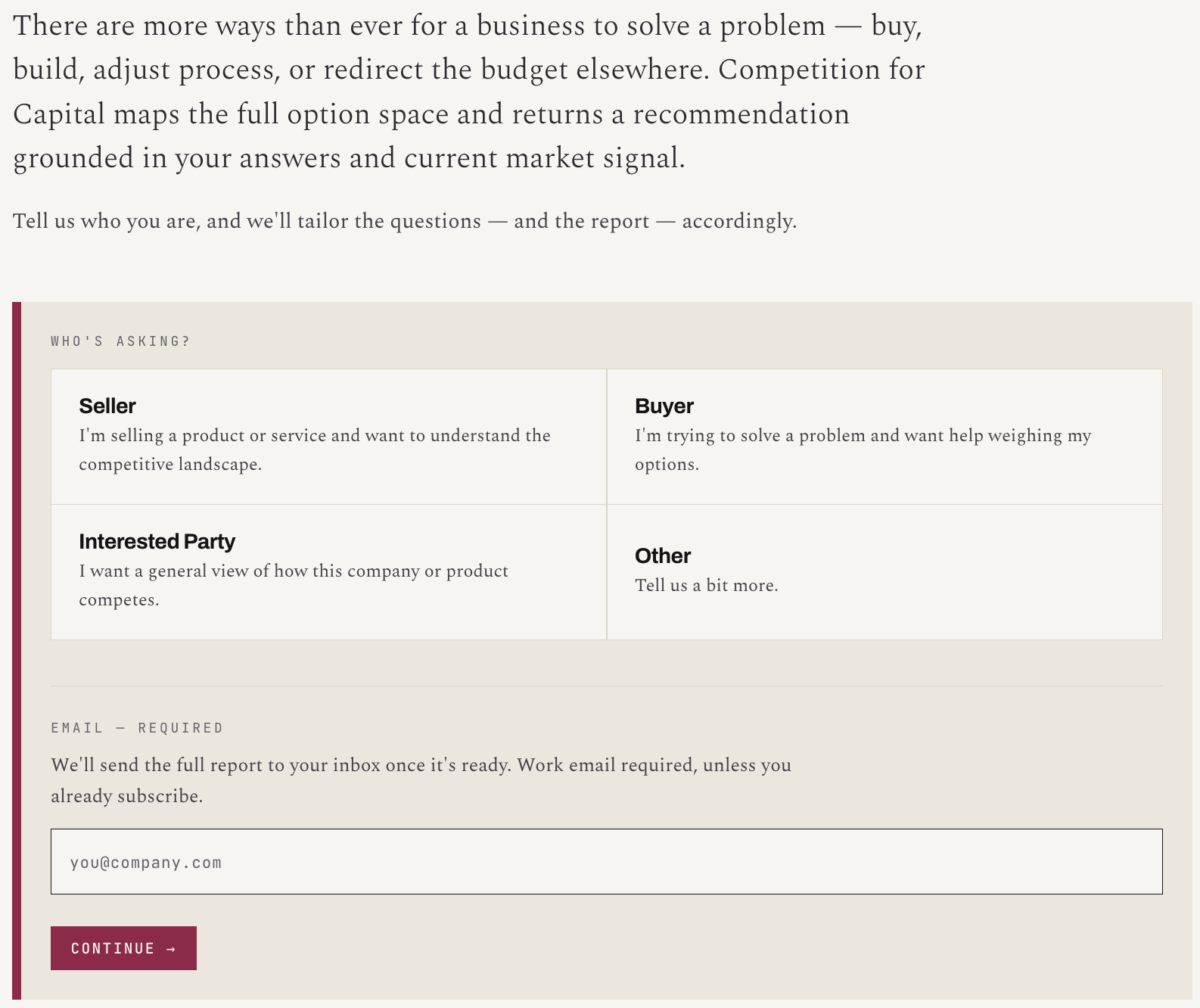
That is why we built Competition for Capital (CfC), a first-principles approach to market intelligence that looks at how real decision-makers allocate time, budget, and attention.
A First Principles Approach (Not Another 2X2 Matrix)
Traditional analyst firms force the market into rigid coverage areas because human analysts can only track a dozen companies at a time before their capacity breaks down. They draw artificial boxes around categories to make them fit into a 2x2 grid or similar static scorecard. They do this not because that is how buyers think, but because that is how the firms package their subscriptions.
CfC flips that model entirely.
Instead of forcing your problem into a pre-defined map, CfC starts with the question you are actually trying to answer. Market boundaries are not fixed, instead they overlap, intersect, and evolve in real time based on buyer demand. CfC maps the option space dynamically, giving a view that evolves as quickly as the market does.
How to Use CfC
Most buyer decisions fail long before a contract is signed because the different stakeholders around the table are working from completely different perspectives.
A CEO is thinking about risk and resource allocation. A CFO is looking at ROI and payback periods. A sales leader is tracking competitor positioning, and a VP of Product is trying to figure out what to build next.
CfC is built around a single, shared source of market truth, tailored to the specific question you need to answer:
For Buyers: Stop asking “Which of these 20 SaaS apps should I buy to fix churn?” Start asking “How should we approach our churn problem from first principles?” CfC provides guidance whether the right answer is buying a point solution, tweaking a process, or reallocating budget elsewhere.
For Sellers & Founders: Get an unvarnished view of where your solution actually sits in the market, including the non-traditional alternatives, internal builds, and adjacent tools your buyers are evaluating against you behind closed doors.
For Investors, Recruiters & Job Seekers: Evaluate a company’s true competitive moat, market trajectory, and positioning before committing capital - or your career.
Why “Capital”?
When we say “capital,” we do not just mean cash. Money is often the easiest resource to measure, but it is rarely the rarest.
Every strategic decision is a trade-off of time, engineering resources, executive focus, and team capacity. When you choose one path, you are implicitly burning capital in all those other forms. CfC measures the entire trade-off, not just the subscription price on an invoice.
Built on AI, Grounded in Experience
Yes, there is serious AI under the hood here, utilizing frontier models including Anthropic's Claude for analysis and reasoning, and Google’s Gemini for embeddings powering retrieval.
Anyone can type a quick prompt into ChatGPT and get a generic summary. CfC goes much further. We have combined sophisticated reasoning with a custom, high-dimensional knowledge engine that maps relationships across thousands of market signals.
More importantly, the system is architected around the methodology I have used over 30 years of evaluating tech markets. It synthesizes market dynamics through an analyst’s framework. As more users query the system, the underlying knowledge layer gets progressively smarter - for everyone.
Pricing: Simple & Grounded
Running high-reasoning AI models and maintaining dynamic knowledge bases incurs real infrastructure costs. Because Differential Factor is completely independent and self-funded, we have tied platform access directly to Substack. This keeps the tool accessible without putting it behind a traditional 5+ figure corporate paywall.
Everyone with a work email gets their first run free — subscribers can use any address.
From there, your usage is tied to your Substack tier:
Free Subscribers: 1 run every 30 days
Monthly Paid Subscribers: Up to 5 runs every 30 days
Annual Subscribers: Up to 10 runs every 30 days
Founding Members: Up to 25 runs every 30 days
(Note: Setting up recurring quarterly market updates counts toward these totals).
No sales pitch, no hidden upsells, and your contact info will never be rented or sold.
Try It Out & Send Feedback
The best way to understand Competition for Capital is to put your own actual business question through it.
Once you’ve run a report, drop a note through our feedback form. Tell us what worked, what surprised you, and where the analysis missed the mark. Your feedback is what will shape the next iteration of the platform.
Thanks for reading, and I look forward to hearing your thoughts.