


The other morning while working out, an unfamiliar, relentlessly chirpy British voice began talking at me through my AirPods. I hadn’t summoned Siri, asked a question, or tapped a button. I was at the gym, working to get through my morning workout and on with my day.
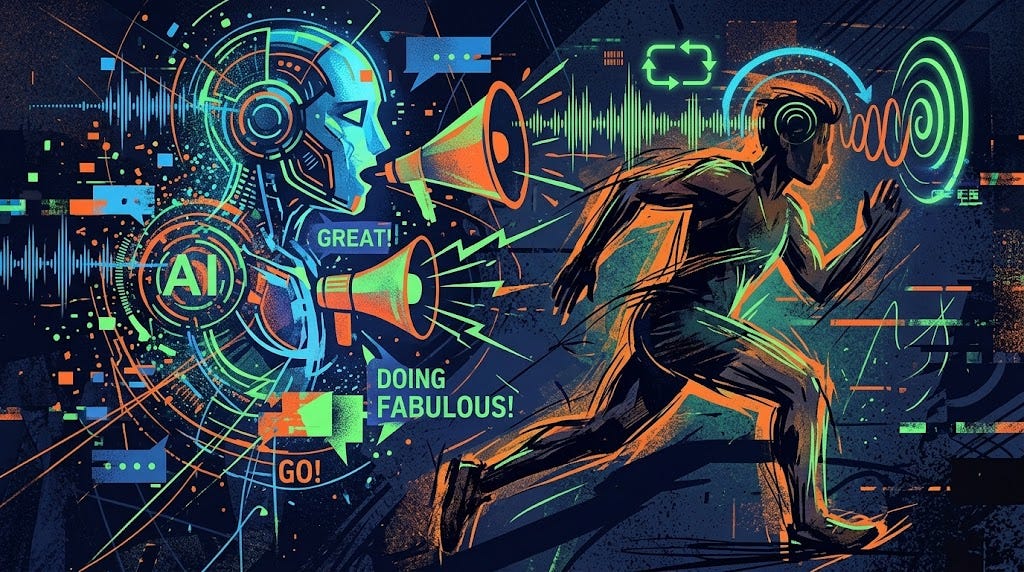
My uninvited “coach” enthusiastically stated that I was off to a great start, doing fabulous, and hitting my targets. Despite the encouraging words, his presence was intrusive and not appreciated.
My new “friend” turned out to be “Workout Buddy,” an Apple Fitness feature tucked into a recent iOS update. While upgrading, I had apparently clicked through the screen agreeing to use it during setup.
The bigger issue, however, wasn’t so much that the feature existed; it was the difficulty of making it stop. I spent the better part of my next few workouts fiddling with menus on my iPhone to no avail. Asking Siri to solve the problem only produced more confusion and compounded my frustration.
When I finally figured out how to turn “Buddy” off, buried inside the Workout app on my Apple Watch, I discovered an even-more-annoying design choice: Workout Buddy had to be disabled on a per-workout-type basis. Silencing it for lifting today didn’t prevent it from piping up tomorrow while on the elliptical. To get rid of it, you need to kill it across every single exercise type that you use.
With all the noise, and of course the marketing spend, behind Meta’s Muse, Google’s Gemini, Apple’s Siri and other personal assistants, it seems likely that the rise of consumer AI is bound to create some boundary issues.
Justifying the Build-Out
Trillions of dollars of capital expenditure continue to be poured into building AI infrastructure. Product teams face immense internal pressure to justify these massive balance-sheet commitments by demonstrating engagement at all costs.
To achieve that, teams risk discarding one of the most bedrock principles of user experience design: software should wait until it is called.
Instead, we have appear to be entering the era of the Uninvited Co-Pilot, though marketers would prefer for you to call them “Agents.”
It isn’t just fitness commentary interrupting the morning workout:
It’s writing assistants highlighting your half-formed thoughts before your fingers leave the keys.
It’s shopping assistants informing you of today’s can’t-miss deals. If you think your email inbox is cluttered, just wait until they get into your voicemail. Or figure out when you’re “available” for a live offer.
It’s search engines plastering synthetic summaries above the actual source links you searched for.
It’s productivity platforms offering predictive auto-replies to emails you haven’t fully read.
It’s mobile operating systems popping up uninvited prompts asking if you need “help” with routine tasks.
When software drives you actively hunt for the off switch, the product team hasn’t built an assistant so much as created digital spam.
Tool vs. Nuisance
The tech industry has a tendency to conflate two radically different product philosophies:
Ambient Capability: Powerful systems that sit quietly in the background, dormant until a human initiates an action, yet ready to execute complex tasks on demand.
Ambient Intrusion: Systems that constantly monitor your context, guess what you might want, and thrust unsolicited advice or interaction directly into your field of view or audio feed.
The former can be leverage. The latter is Clippy with an LLM as a backend and a more intrusive attitude. Think Alexa’s “By the way” suggestions on steroids.
When I need research synthesized, datasets organized, or code debugged, AI can be transformative. In those situations, I’m in the driver’s seat: defining the context, executing the instructions, and evaluating the work. AI acts as Steve Jobs’ classic “bicycle for the mind.”
But when AI flips that dynamic—speaking without being spoken to, nudging without consent, and elbowing into activities where we prefer solitude and focus—it ceases to be helpful and crosses the annoying line.
The Jobs-to-Be-Done Reality Check
In my Northeastern classes, we frequently discuss Clayton Christensen’s classic “Jobs to be Done” framework: what problem is the user actually “hiring” a product to solve?
Today, consumer AI features are rarely being hired to solve a pressing user problem, although not for a lack of trying. Instead, they are being hired to solve an enterprise problem: justifying billions in infrastructure buildout by forcing engagement metrics onto users who never asked for them.
The WSJ’s Greg Ip recently suggested that to justify the current scale of global AI capital investment, consumers would need to spend 9% of GDP—effectively equivalent to what we spend on food. This in the teeth of a model price war that’s just getting started. This pressure for growth is likely to push AI into every one of our waking moments, invited or not.
Are Frontier Models Overshooting?

There’s a noisy debate taking place around whether the surging demand for AI justifies the staggering amounts of capital being poured into supplying it. But most of this commentary is happening without looking closely at what buyers are actually doing in the real world.
Yet when I poll my students—the same demographic Silicon Valley assumes will live in an AI-saturated, always-on reality—most of them seem not particularly interested in these unsolicited agentic tools. They use AI when it serves a direct, deliberate purpose, and ignore or disable the rest.
If tech companies continue to force AI into places where it intrusively degrades the user experience, consumer fatigue will quickly set in. When markets eventually correct, the danger is that users and investors alike will toss the baby with the bathwater, and dismiss genuine productivity breakthroughs because they are fed up with synthetic companions chattering in their ears.
Give Me AI That Knows How to Wait Its Turn
The future of consumer technology won’t belong to the loudest algorithm or the most omnipresent bot. It will belong to software that best respects human boundaries.
I certainly don’t mean to pick on Apple. If anything, they’ve been one of the better actors in observing best practices with consumer data protection and privacy. Part of what made my recent experience with Workout Buddy so annoying is that Apple’s products are normally both intuitive and not intrusive.
I recently posted about Meta’s Muse, which I briefly tried and almost immediately disconnected from my accounts. This was in part because of a lack of trust with Meta—who famously have not been among the good guys in terms of protecting privacy—but also because I just don’t need an assistant chirping at me all day for all the things it can do for me. Life’s busy enough, and the last thing I need are more “suggestions” - perhaps I’m speaking for myself, but I don’t really think so.
Musing on Consumer AI

Enterprise deployments grab all the headlines, but consumer AI is where things are getting really interesting. Meta, of course, just rolled out Muse, and I spent the past few days kicking the tires. Muse offers an intuitive UI and a slew of helpful connectors, but in practice Muse doesn’t feel drastically different from my day-to-day setup with
Real intelligence isn’t demonstrated by chiming in at every available moment. Synthetic motivation from an algorithmic cheerleader, for me at least, is AI slop at its’ worst.
The upside with AI is massive, but the already significant backlash is only going to get worse if the technology annoys more consumers than it empowers. Vendors are advised to train their models on the single most valuable design pattern in tech: speak only when you’re spoken to.