

The Calculus of Disruption
Navigating the rate of change in an agentic economy

I’ve spent decades as a software executive, working both with and (earlier) within the research industry - and the last few years in the classroom. Differential Factor is an idea I’ve been working on for a while - where those three worlds finally collide.
I’m not particularly interested in launching yet another “thought leadership” Substack. I’m building this because the I fundamentally believe that the legacy research model isn’t right for the era we are in. Legacy research is too slow, too vendor-centric, and most importantly it’s ignoring a fundamental shift in how the economy actually operates.
As I’ve said so many times in my career, there’s always a market for good advice. Emphasis on “good” - and these days “good” means “encompassing change”. Lots of it.
If you’re reading this, I want you in the mix as we figure out what should come next - and help me build it together.
Why “Differential”?
In calculus, a differential represents a rate of change. In business, the obvious changes aren’t the ones that kill you—it’s the second and third-order impacts that redefine markets. This focus on the rate of change is built on three pillars.
1. The Classroom as a Real-Time Lab
Teaching Industry Disruption & Corporate Innovation at Northeastern has given me a vantage point I didn’t have as an operator. In the classroom, we dissect the theories of academic giants such as Clayton Christensen, Aswath Damodaran and my colleague Fernando Suarez. But today, we aren’t watching “disruption” happen over decades; we’re seeing it happen over quarters.
Standing in front of 50 sharp students every week forces a certain rigor. You can’t just lean on theory, but neither can you rely on “gut feel” or headlines. I come into the classroom with a syllabus that stays consistent, yet the economy changes so quickly that the details wind up entirely different. The classroom is my “check” on reality.
2. Bridging the Legacy Research Gap
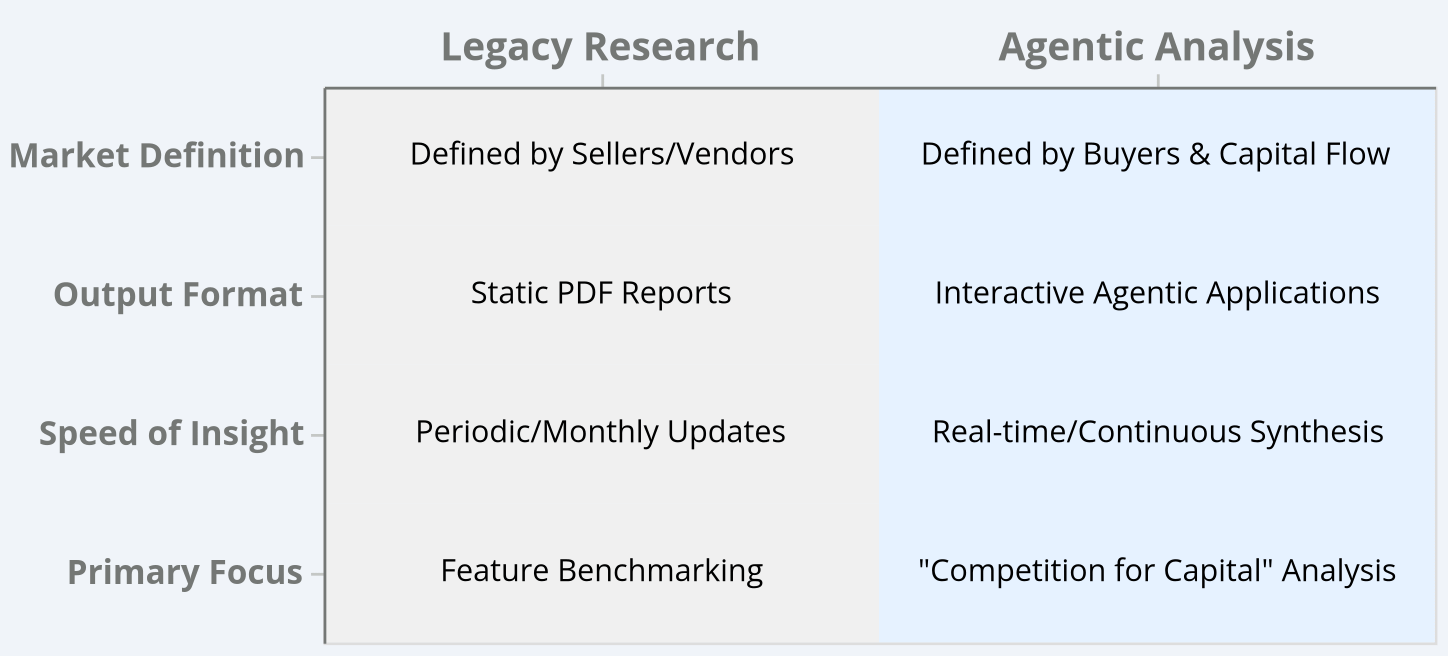
My early career was defined by tech research —first at Yankee Group, where I was fortunate to learn from my good friend, mentor and industry legend Howard Anderson, and then founding Reservoir Partners before I merged it with Aberdeen Group. Looking at the industry today, it’s shocking how little has changed since those late ‘90’s, early 00’s days. The model remains “seller-centric,” and it fundamentally misses so much of the reality we’re all living:
Markets are Buyer-Defined: Legacy analysts categorize tech by what vendors build and sell. But buyers make the decisions and control the budgets - and they care about the problems they are solving.
Silos are Collapsing: Rigid categories and TLA (three-letter acronym) proliferation (CRM, ERP, HCM, etc…) prevent analysts from seeing the cross-boundary shifts where true innovation happens. Too much of the industry is using 1996 categories to describe 2026 problems.
The “Competition for Capital”: Today’s buyers aren’t just choosing between two software vendors; they are choosing whether to buy software at all, hire more people, vibe code (keep reading…), or invest in a different category entirely. The CFO isn’t comparing your tool to your competitor; they are comparing your SaaS bill to the cost of their headcount, or their Claude Code tokens.
This isn't just about better software; it's about a fundamental shift in the macroeconomics of innovation—where policy, capital, and agentic workflows are redrawing the map of the tech economy.
3. From Analysts to Agents
We are entering the “Agentic” era. The legacy research model relies on humans producing static PDFs based on static surveys. That’s of limited usefulness in this day and age - those PDFs are out of date they day they’re published.
Differential Factor is an experiment in what an agent-led research business might look like. Inspired by the work my Northeastern colleague Nik Bear Brown is doing with living models and causal intelligence, we are going to be building tools that ingest data in real-time. Rather than producing static PDFs, we want to see the market shift dynamically - while it’s actually happening - and track it as it evolves.
To put this agentic approach to the test, our first project tackles one of the most talked-about friction point in the market right now: Vibe Coding. There’s so much noise about how AI is changing the “build vs. buy” equation, and the “vibe” is that high-velocity, AI-augmented builds are going to replace legacy enterprise software buys. With apologies to Marc Andreesen, software may have eaten the world, but AI is rapidly eating software.
Yet there are strong counterarguments that large enterprises - and even the not-so-large ones - won’t be so quick to rip out their core workflows and systems of record.
The opportunity for change is enormous - but while there are many opinions - there’s little to no data. Our goal is to change that - by deploying agentic tools to track where the money is actually moving. Are buyers truly pulling capital away from SaaS giants to build their own tools? Our goal is to find out—and we’re intending to share the data right here for you to kick the tires on.
This sounds to me like Disruptive Innovation defined. The Innovator’s Dilemma is happening in real-time - right now - in the enterprise software industry. I’ve spent my career in this space, and I can’t think of a better time to be looking at it.
The Road Ahead
Intellectual curiosity is my only compass here. Differential Factor starts as a solo effort, but it only works if it’s a conversation—and a community. I’m not interested in being a lone voice in a digital wilderness; I’m looking for the practitioners and skeptics who want to kick the tires - and burst the hype bubbles - with me.
In the coming weeks, I’ll be releasing the first data sets from our Vibe Coding project, along with the agentic tools we’re using to track them.
In the meantime, I’m glad you’re here for Day 1. And I’d love to hear from you.
Let’s get to work.
Interesting concept, I am definitely intrigued. I will be back with more comments after doing a little old fashioned research to get a little more up to speed. I suspect the gating factor will remain risk aversion from organizations that don't "need" a new model.
I had a few initial thoughts but the first one was: The inability of businesses to adequately define their requirements in traditional build environments was a major driver of time and cost. Can AI effectively drive that requirements definition to achieve development of large, complex systems that are at least minimally functional at scale? Or are we talking about more easily defined point solutions? Or do I just not grasp the concept?