


I’m really looking forward to tomorrow’s Spain vs Argentina World Cup final. Before the teams kick off, here is what the WC2026 model actually predicts, along with a few things a month+ of live, public forecasting taught me.
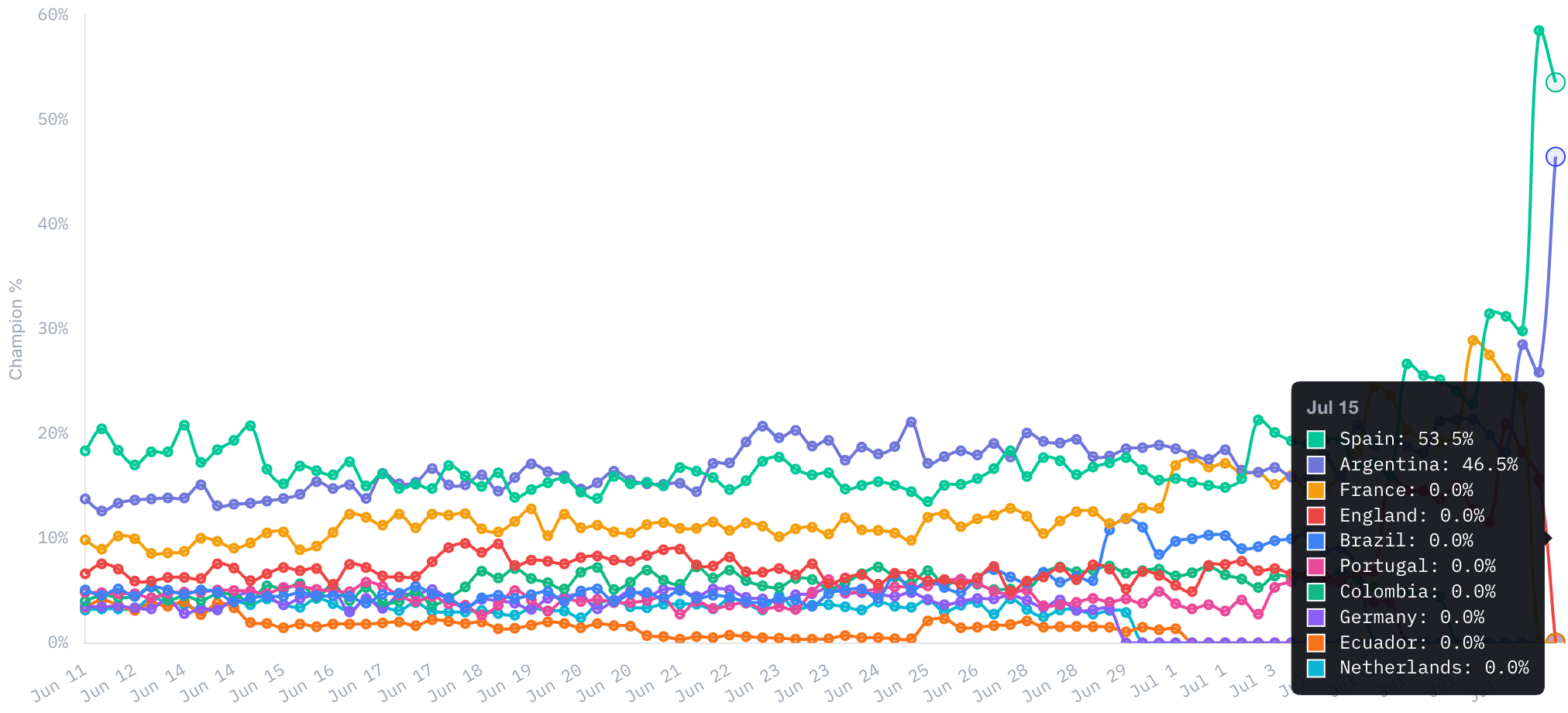
As you can see, the model puts Spain ahead at 53.5% to Argentina’s 46.5%. Certainly not a landslide, but the numbers favor La Roja. Interestingly, Spain being the favorite over Argentina is exactly where we started on day one.
Spain got here by looking like the better team in practically every round, capped off by a dominant 2-0 semifinal win over France. Argentina, on the other hand, barely survived. They needed extra time to get past a massive underdog in Cape Verde during the round of 32, and then had to mount a thrilling comeback win against England in the semis.
Both pre-tournament favorites made it to the final, but only one of them made it look easy.
How the model did
We (my friend Claude and me) built this model to be intentionally simple: no scouting network, no proprietary data feed, no black box. The goal was never to out-think the pros1. It was to see how far a simple and honest model could get on its own.
The final numbers look better than I expected. Through the group stage, our simple model called winners correctly 60% of the time, while the market hit 67%. By the semifinals, that gap narrowed to nearly a third. For a bare-bones project tracking a multi-million dollar market backed by real money and massive data feeds, staying in the conversation feels like a win.
But I have to put a pretty big asterisk on that scorecard: the main reason the model looked so smart in the back half is that the world behaved exactly the way it was supposed to - because the favorites kept winning. The four teams almost every serious pre-tournament projection — including ours — flagged as the real contenders were Argentina, Spain, France, and England. Those are exactly the four teams that reached the semifinals. A final between the two pre-tournament co-favorites is about as predictable an outcome as a 48-team tournament can produce.
A simple model can look very smart when the world behaves the way it’s supposed to. The real test — the one that actually separates a good model from a lucky one — is what happens when it doesn’t.
This tournament had a stretch of upsets early on in the group stage, and that’s exactly where the model hiccuped. A simple mathematical model relies heavily on historical class and baseline ratings. What it can't factor in is human chaos, such as a massive underdog like Cape Verde playing with absolutely nothing to lose, or a team resting its starters because they've already locked up a spot in the knockouts as the USMNT did against Turkiye. Once the tournament settled down in the knockout stage and the contenders sorted themselves out, so did the model’s job. Worth remembering before crediting the method for what the field mostly did on its own.
One more thing before we close it out
Even in the home stretch, we ran into a stubborn bug on the UI side that took a full day and several wrong guesses to track down. It didn’t touch the actual predictions, but it was a healthy dose of humility and a reminder of a basic truth when you’re building things: a system can look perfectly polished and confident on the outside while being quietly broken on the inside.
I wrote about this dynamic earlier in the tournament in Confidently Wrong —it’s the classic engineering trap where a bug behaves exactly like a feature until it suddenly doesn’t. You don’t fix those moments by spinning up a more complex theory or cleverer reasoning. You fix it by stopping, throwing out your assumptions, and demanding the system show you exactly what it’s doing under the hood.
What’s next
Regardless of what happens tomorrow, the full model, every prediction, and the scoreboard stay public at wc2026.differentialfactor.com. I’m also planning to use this experience in the classroom at Northeastern this fall as a teaching moment or two.
I’m considering whether I want to build another model for the upcoming Premier League season, but I may just choose to enjoy the games instead. #COYG
"The pros" here is Pinnacle's closing lines, pulled automatically via The Odds API — with the first few weeks backfilled by hand from OddsPortal before that automation was live.