


First of all, I haven’t yet seen the film Backrooms, so apologies to anyone who opened this expecting a movie review. But the concept of hidden, surreal spaces behind everyday facades feels oddly relevant to where we are right now.
Quite a few years ago, near the end of the dot-com boom, an old friend invited me to speak to a local Chamber of Commerce in upstate New York. He had recently moved back to his hometown, which was exploring ways to create local jobs by building a call center to replace the many jobs lost due to a recent auto plant closure. Upon arrival, I was ushered into a shuttered Woolworths department store where I was to deliver my speech, filled with abandoned mannequins and empty hangers.
Then someone said, “Let’s check out the back room.”
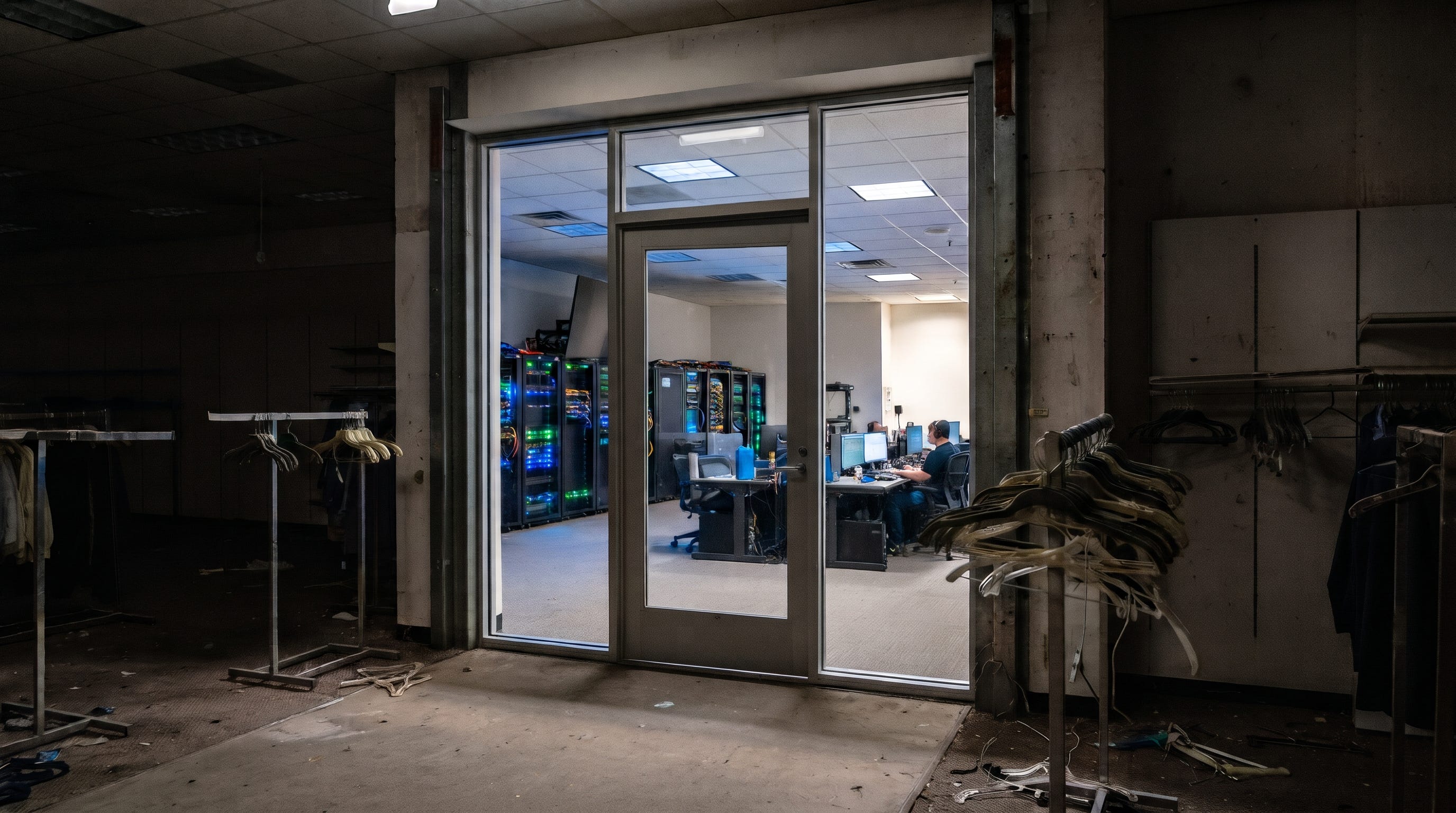
Behind a heavy door lay a gleaming, state-of-the-art Network Operations Center (NOC) packed with brand-new telecom equipment. When I asked how a struggling town paid for it, I learned the vendor—Nortel—had provided the gear essentially on credit.
Echoes of Telecom in the AI Market
I think about that back room often as we watch today’s AI infrastructure buildout power ahead through increasing political and financial headwinds.
At the center sits Nvidia, often called the “Central Bank of AI.” While financially robust, heavy circular financing and interdependence certainly create some very real vulnerabilities for the company - and the industry. And of course last week’s news regarding founder and former CEO Jensen Huang doesn’t help. If demand softens, over-leveraged infrastructure could trigger a sharp market correction.
But let’s recall how the telecom bubble played out. Yes, there was immense speculation, excessive leverage, and multiple bankruptcies. WorldCom, Qwest, Global Crossing and others were essentially the “NeoClouds” of the late ‘90s. But the fiber laid down during that frantic era didn’t stay dark. Once the dust settled, that physical infrastructure lit up, powering decades of economic growth. So much of what we take for granted today—high-speed broadband, video streaming, cloud applications—was built on top of that initial surge. The pioneers were overleveraged, but the underlying utility was real.
Leadership Shifts and Market Confidence
Markets run on confidence, and we’re seeing that tested with Nvidia’s high profile leadership transition, as the company faces a pivotal earnings report this week. At the same time, investor appetite for the broader sector remains remarkably robust, underscored by Anthropic’s about-to-be successfully priced IPO, which is reportedly six times oversubscribed as it heads toward its debut.
Keep in mind, however, that an IPO is a starting line, not a finish line. Pricing at a sustainable valuation demonstrates that Anthropic’s management is taking a long-term view focused on enduring performance rather than short-term hype. As a heavy user of Claude, I’m continually impressed by their capabilities and the massive Total Addressable Market (TAM) they are targeting.
Beyond Tokens: The New Application Layer
Skeptics argue that companies like Anthropic and OpenAI are just raw Large Language Model (LLM) businesses lacking defensible moats as token prices trend toward zero.
That might be true if selling tokens were the long-term model. I believe, however, the real value creation is happening at the workflow and application layers:
Anthropic is building an integrated suite of productivity tools. I continue to be impressed with Claude Docs, Claude Slides, Claude Design, Claude Meetings, and most recently Claude Duet. (I have a few invites, DM me if you need one).
OpenAI is expanding its consumer and business ecosystems through Operator, Dots, and ChatGPT Search.
Google continues to deeply embed Gemini across its Workspace ecosystem, and as I wrote previously, I see massive opportunity on the consumer side.

The “LLM” companies are moving beyond raw model endpoints to capture potentially massive TAM across enterprise productivity and workflow automation—driving the evolution away from purely token-based revenue models.
Looking to the Horizon
We are clearly entering a bumpier phase of the AI “bubble.” Circular financing risks, executive transitions, and model commoditization will create near-term volatility.
Yet just like the telecom buildout decades ago, the core transformation taking place is very real. The companies that focus on building durable application ecosystems and real workflow utility will shape the next era of computing. It pays to stay cautious and diversified, but keep your eyes on the horizon—extraordinary, lasting value is being built right in front of our eyes. Markets will tell us much this week about whether investors agree.